Hachinohe
Second-largest city in Aomori Prefecture, major port and industrial hub.

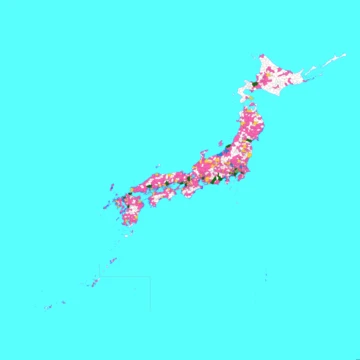
Hachinohe is a city located in Aomori Prefecture, Japan, on the southeast coast facing the Pacific Ocean. The city serves as the regional industrial and commercial center for eastern Aomori Prefecture, with a major port that handles one of the largest volumes of landed fish in Japan and a diverse coastal industrial belt.
Lore & Background
The area around Hachinohe has been occupied since prehistoric times and was a major population center for the Emishi people. Numerous Jōmon period remains have been discovered within its borders. The town prospered as a castle town centered on Hachinohe Castle and served as a small commercial centre and port for fishing grounds off southeastern Hokkaido. After the Meiji Restoration, Hachinohe Domain was abolished and replaced by Hachinohe Prefecture, which was subsequently merged into Aomori Prefecture. The Meiji government decided to build a new town called Aomori as the capital rather than Hachinohe or Hirosaki due to rivalry between former domains.
Reader's Guide
Hachinohe's significance lies in its dual role as a historic castle town and a modern industrial and commercial center. Major industrial parks include the Hachinohe High Tech Park and Hachinohe North-Interchange Industrial Complex. The Hachinohe Thermal Power Station, an LNG-fired power plant operated by Tohoku Electric, is located in the city. Hachinohe Port is a major international port for northern Japan. The city is also a transportation hub, served by the Tōhoku Shinkansen, the Hachinohe Line, the Aoimori Railway Line, and several expressways. Local attractions include Kabushima island, a habitat for forty thousand black-tailed gulls and a national Natural Monument; the Tanesashi Coast, a nationally designated Place of Scenic Beauty; and the Emburi festival, held February 17–20, which prays for a bountiful harvest. The traditional handicraft Yawata-uma, a wooden horse figurine, reflects the area's history of horse breeding since the Kamakura period. Hachinohe's legacy is that of a resilient city that has evolved from a feudal domain to a core city with increased local autonomy, while maintaining its cultural traditions and adapting to natural disasters.
Did You Know?
- Kabushima island offshore Hachinohe is a habitat for forty thousand black-tailed gulls and is a national Natural Monument.
- The Hachinohe Thermal Power Station, an LNG-fired power plant operated by Tohoku Electric, is located in the city.
A Name Rooted in Place
Vanraure Hachinohe carries a name that is as much a geographic statement as a brand. The word blends two Italian terms—derivante, meaning "origin," and australe, meaning "southern"—to point directly to the club's birthplace in the southern part of Hachinohe, specifically the former village of Nangō. The Italian flavor of the name sets the club apart in a Japanese football landscape dominated by English or Japanese monikers, while the "southern" reference keeps the team tethered to a small community rather than an abstract corporate identity. Every match the club plays, from regional cup ties to national league fixtures, carries the weight of that local identity—two clubs, one village, one shared ambition stitched into a single name.
A Decade of Near-Misses
The path from a regional league side to professional football was anything but linear. The following year they finished second behind Ganju Iwate, salvaging a promotion playoff victory over Cobaltore Onagawa only because Fukushima United's own JFL promotion opened a slot.
Forged by Disruption
Vanraure Hachinohe's history is punctuated by external shocks that tested the club's resolve. Vanraure won that disrupted season's title, but the victory carried no advancement—a bittersweet footnote in a year already defined by national tragedy. The following season brought its own frustration: a second-place finish behind Ganju Iwate, with promotion ultimately secured through a playoff against Cobaltore Onagawa, a slot opened only because Fukushima United earned their own JFL promotion. Each disruption forced the club to adapt, wait, and fight for a place that was never guaranteed.
Frequently Asked Questions
What is Hachinohe?
Hachinohe is a coastal city in Aomori Prefecture, Japan, situated along the southeast shore where the land meets the Pacific Ocean. It functions as the primary industrial and commercial hub for the eastern half of the prefecture.
Where exactly is Hachinohe located?
The city sits on Aomori's southeastern coastline, directly facing the open waters of the Pacific. Its position gives it a long stretch of working waterfront that anchors the local economy.
What is Hachinohe best known for?
Its deep-water port consistently lands one of the highest volumes of fish in the entire country, making it a cornerstone of Japan's seafood supply chain. Beyond fishing, a broad coastal industrial belt stretches along the shoreline, handling manufacturing, logistics, and trade.
Why does Hachinohe matter to Aomori Prefecture?
It serves as the economic engine for eastern Aomori, concentrating the region's port operations, heavy industry, and commercial activity in one place. Without Hachinohe's infrastructure, the surrounding communities would lack the industrial backbone that defines the area's identity.
More in Japanese Cities 1-23
Spotted an error? Know more?
This is a living reference — every entry is fact-audited, and reader corrections feed straight into our audit queue. Suggest an edit · See this site's audit record